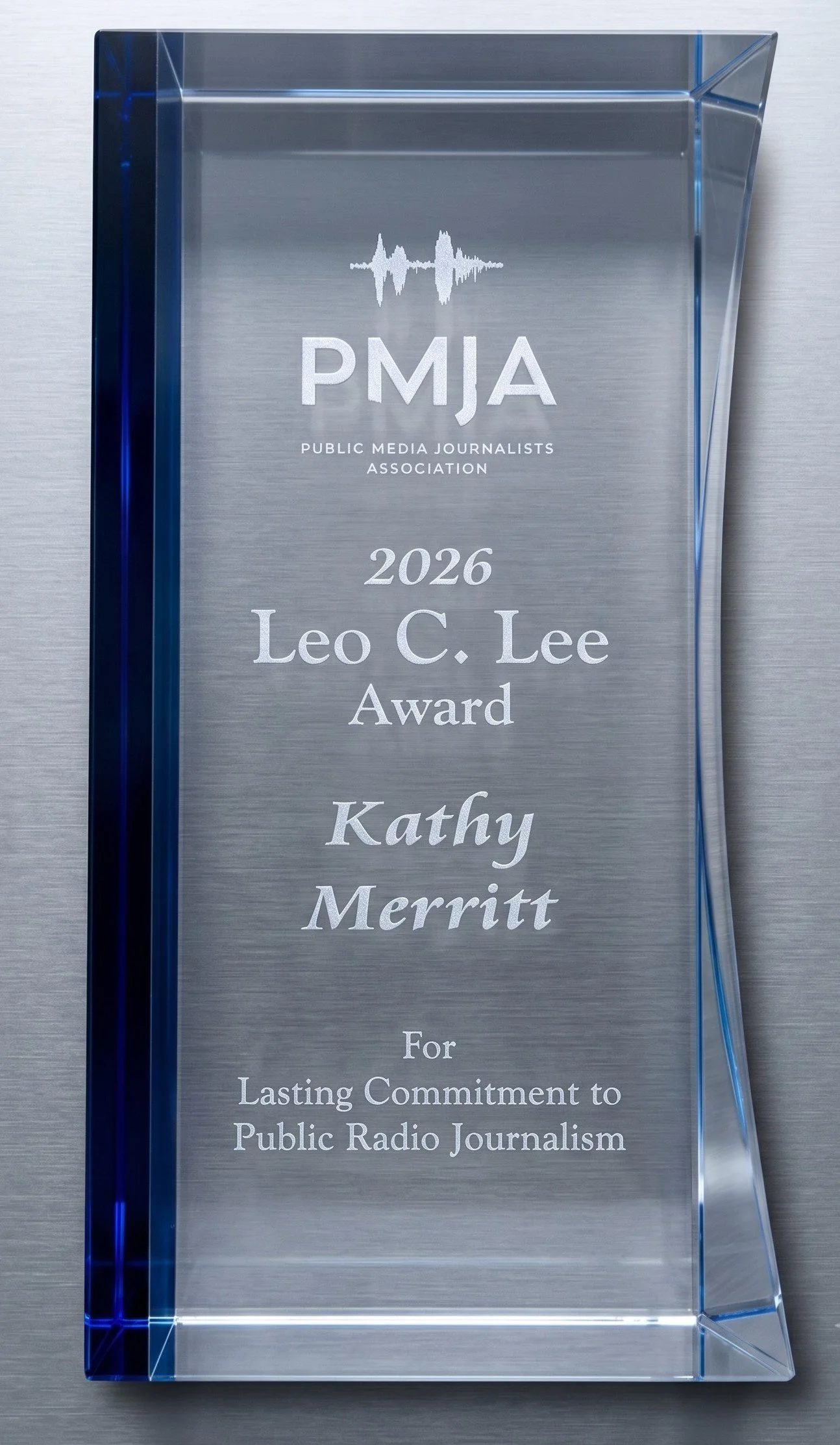
Remarks on accepting the Public Media Journalists Association’s Leo C. Lee Award
July 21, 2026
Thank you, Joy (Lin). And thank you to Christine (Paige Diers) and the PMJA board.
This organization has meant a great deal to me for a very long time. I was there for some of the earliest meetings of its predecessor, Public Radio News Directors, Inc. — a group of news directors who came together to support one another and, frankly, to make clear to NPR that local newsrooms were essential to the public media ecosystem and that news directors deserved to be treated as true colleagues. Our work in those early days strengthened the relationship between stations and NPR and helped build the training, professionalism, and community that still define PMJA today.
I’m grateful for Joy’s kind introduction. She was central to our work at CPB— supporting collaborative journalism, emergency coverage, and national productions including frontline, PBS NewsHour, and NPR’s international reporting. None of that happened in isolation. It was a team effort at CPB, with great colleagues in finance, legal, the COO’s office, and especially in our radio, journalism, and CSG department. I’m grateful to everyone who worked there, and we are all saddened by the news of the death of our colleague Sylvia Bugg, who left CPB to become head of programming at PBS. And we send our condolences to her loved ones.
As I thought about what to say today, I found myself reflecting on where my own journalism journey began. It started at home. My parents didn’t have college degrees, but they had — and my 94‑year‑old mother still has — an insatiable curiosity about the world. My father read the entire newspaper every day, front to back. My mother listened to news/talk radio in the kitchen, and we never missed the evening news on TV. From them, I learned that paying attention to your community, your country, and the world isn’t just interesting — it’s a responsibility.
I decided early on that I wanted to be a journalist. My opportunity came in college, when a public radio station in Charlotte was working to qualify for CPB funding and go on the air. I started as a part‑time production assistant at WFAE and eventually became news director.
We were a young team in a growing city. Charlotte was adding professional sports teams, attracting national corporate headquarters, and of course, we had the Jim and Tammy Faye Baker story. There was never a shortage of news.
From there, I went to WAMU in Washington, DC — another place where the news was never in short supply. We covered the final years of Marion Barry’s time as mayor, congressional pressure on DC government, and the rapid growth of the region. Our weekly news magazine let us dig into features and cultural stories, and our diverse staff gave our coverage breadth and depth. We won a lot of awards, and I’m proud of what we did and to see the careers of the journalists who worked there, including Julianne Welby and Annie Wu who are here today.
After 20 years in the newsroom, I moved into management, but journalism remained central to my career — especially at CPB, where I could put my newsroom experience to use in a different way. We saw the decline of local news in many places across the country as newspapers failed, and began investing millions in local, regional, and national reporting. I was able to work with some of the best journalists and station leaders in public media to strengthen their projects, to build collaborations, and train editors. We supported PMJA’s Editor Corps, which I think has been a fantastic initiative that’s helped many newsrooms. Through all this work, I learned about how newsrooms were changing and the new ways they were engaging with their communities.
I learned things I wish I had known when I was a news director. When I look back at my newsroom days, I was often too focused on my own ideas about what constituted “news.” I should have spent more time outside the newsroom, getting to know the neighborhoods, listening to people’s stories. I shouldn’t have let my own assumptions about what was news lead my editorial decision making.
So, with that in mind, I offer these thoughts on the job of news director today:
First: know who you work for. It’s not you, and it’s not your colleagues. It’s your audience — the people who rely on you to help them navigate their community and their lives.
Second: know the job to be done. A new study from the Merrill College of Journalism at the University of Maryland called “The News People Need” states that news organizations need “to create journalism that is more actionable, useful and indispensable.” The respondents in their research identified six jobs to be done:
Give me agency over what’s happening
Give me the long view to understand my community today
Help me see the invisible systems shaping people’s lives
Give me the street-level view
Help me navigate right now
Help me engage with what’s great about my community
In short, journalism is civic infrastructure. It equips people to make decisions, find resources, and understand the place they call home. And while we need more accountability reporting — sometimes a voter guide, or a morning newsletter, or coverage of the World Cup in your city will more immediately meet the needs of your community.
Third: talk to real people. Too many times, I hear journalists interviewing other journalists or doing two-ways with experts. Sometimes that’s the best way to get information across, but it’s not a substitute for talking to people who live the impact of the story. PMJA’s special awards category this year — Federal Policy, Local Impact — gets this exactly right. Coverage is richer when you hear the voices of those affected.
Fourth: add context. Not everyone knows the backstory or the consequences of what you’re covering. People want meaning, not just facts. Use the “call mom” approach: if you were explaining the story to your mom, where would you start? What would she need to understand first? Don’t be afraid to explain the basics or take the time to explain the complexities of a story. Research consistently shows that many people think public media is “not for them,” and I believe it’s because we too often deliver news in a shorthand that assumes the audience knows what we’re talking about.
Finally: be curious. Don’t rely on your own assumptions about what matters. When you deliberately widen your perspective, you create room for journalism that is more authentic, more rooted in community, and less shaped by the gravitational pull of everyone else’s coverage. Curiosity keeps your work honest — and keeps you connected to the community you serve.
My hope is that combining these approaches with a steadfast commitment to editorial integrity builds trust. Public media should be a place people turn for reliable, trusted journalism: an oasis of audience‑centered, contextual information, driven by curiosity and grounded in real people.
Thank you for the work you do every day. You make a difference. Congratulations to Sylvia Goodman and Elaine Clark on their awards.
And thank you again for this award. I’m humbled to join the company of previous recipients and grateful for this recognition.